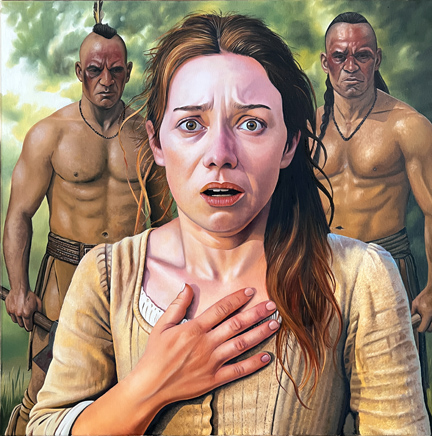
Jane McCrea Murder in Fort Edward
30″ x 30“, Oil on Canvas, 2025
by Charles C. Clear III
Fear On The Frontier
Jane McCrea was a young woman engaged to a Loyalist officer during the American Revolution. In the summer of 1777, as General John Burgoyne’s army advanced south from Canada, she waited near Fort Edward, hoping to reunite with her fiancé so they could marry. Instead, Native warriors allied with the British captured her during the campaign. She died soon afterward, and news of her death spread rapidly through both armies, shaping one of the most enduring and controversial stories of the war.
Artists have returned to Jane McCrea’s story for more than two centuries. Many historical images fixate on a single moment of violence, reducing her to a symbol within a larger political narrative. Such portrayals often reveal more about the fears and propaganda of their own time than about Jane herself. They depict spectacle rather than personhood, transforming a young woman’s final moments into an emblem of conflict.
The Real Jane McCrea
This painting seeks another path. It approaches Jane McCrea not as an icon of tragedy, but as a human presence — young, vulnerable, and fully alive within a fleeting moment of uncertainty. Her hair falls loose, her linen dress bears the strain of travel, and she stands isolated within the wilderness. Figures surround her at a distance, their painted faces and visible weapons forming a tense and unsettling perimeter. The focus, however, remains on Jane: her expression suspended between fear and comprehension, her body poised at the threshold between past and future.
Historical accounts differ about the precise circumstances of her death. Some historians suggest a single gunshot wound to the chest. In this portrait, her hand rests over her heart, introducing a deliberate ambiguity. Is she steadying herself against rising panic, or has the fatal moment already arrived? The painting refuses to resolve the question, inviting viewers to inhabit the uncertainty rather than observe a predetermined narrative.
The Art of War
Jane McCrea’s death quickly entered Revolutionary War propaganda, where it served competing political purposes and fueled public outrage. Yet behind the rhetoric stood an individual whose desires were profoundly ordinary: to reunite with the person she loved, to marry, and to live a life defined by personal rather than political destiny. By shifting attention away from spectacle and toward interior experience, this work attempts to restore a measure of dignity to a figure long overshadowed by myth.
Ultimately, the painting asks viewers to move beyond history as abstraction. It invites a quiet encounter with a single human life poised at the edge of loss — a moment suspended between memory, interpretation, and empathy.
Charles C. Clear III
cc@oceanstateart.com