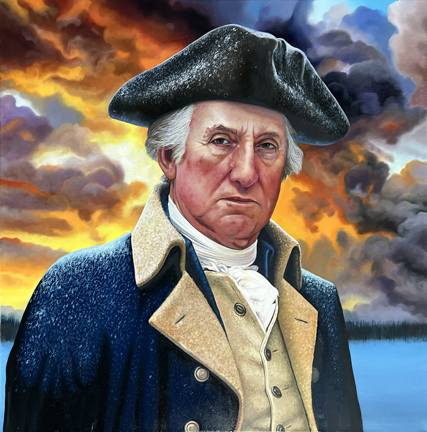
George Washington Portrait
30″ x 30“, Oil on Linen, 2025
by Charles C. Clear III
The Battle of Trenton – December 26, 1776
As 1776 drew to a close, the dream of American independence was rapidly slipping away. The Continental Army had suffered a series of defeats—at White Plains in October and at Forts Washington and Lee in November—and morale had collapsed. Chased relentlessly by British forces, General George Washington retreated across New Jersey and into Pennsylvania. His army, clad in threadbare uniforms and many without shoes, had dwindled to only a few thousand men. Enlistments were set to expire within days. Desertions mounted. Supplies were scarce.
In a letter to his brother John, Washington confessed the gravity of the moment: “If every nerve is not strained to recruit the new army with all possible expedition, I think the game is pretty near up.”
There would be one last, desperate attempt to revive the cause of liberty.
Washington devised a daring plan—to strike the Hessian garrison at Trenton by ferrying his army across the ice-choked Delaware River on Christmas night. The goal was not only to seize supplies, but to reignite American morale through shock and audacity. Originally conceived as a three-pronged attack, the plan was nearly undone by a violent nor’easter. Snow, sleet, and driving wind forced two columns to turn back. Only the main force, with Washington at its head, completed the perilous crossing nine miles north of Trenton.
On the morning of December 26, 1776, George Washington personally led the attack. He commanded the central column advancing from the north, directing troops as they engaged the stunned Hessian defenders. The victory at Trenton was swift and decisive—and utterly transformative. It saved the Continental Army and restored belief in the possibility of independence.
George Washington: A Portrait of Resolve
In traditional portraits—from Gilbert Stuart’s composed statesman to Emanuel Leutze’s heroic allegory—Washington appears almost mythological: elevated, timeless, removed from physical hardship. I wanted to paint something different. I wanted to paint the human Washington.
This portrait depicts Washington after the Battle of Trenton. Imagine standing beside him on that bitter winter morning as he turns toward you. He is victorious, fully aware of the immense significance of what has just occurred—but his face reveals exhaustion, strain, and cold. His wool coat is heavy with snow and wet from the river crossing. The cost of command is written plainly across his features.
Behind him, the sky burns with fire and smoke from the battle. Yet dawn is breaking—both on the day and on a new nation.
This is Washington not as an icon, but as a man: burdened by doubt, subject to fatigue and fear, yet resolute enough to press forward when everything seemed lost. He did not merely win a battle—he seized history at its most fragile moment and bent it toward possibility.
Charles C. Clear III
cc@oceanstateart.com