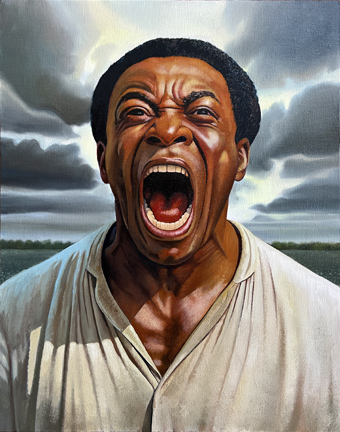
Solomon Northup’s 12 Years of Rage
24″ x 30“, Oil on Linen Panel, 2025
by Charles C. Clear III
Solomon Northup was born around 1807 in Minerva, New York. His parents were free, successful farmers and landowners who valued education and ensured their children received one. Over time the family moved through Washington County – living in Granville, Hudson Falls, and Fort Edward – where Solomon married Anne Hampton and together they raised three children.
In 1834, seeking greater opportunity, the Northup family relocated to Saratoga Springs. Solomon worked a variety of jobs, most often manual labor, but he was also a gifted violinist. His musical talent earned him work performing at several prominent hotels in Saratoga, allowing him to supplement his income and support his family.
In 1841, Solomon was approached by two men who offered him paid work playing his violin in New York City and Washington, D.C. They presented themselves as respectable businessmen. They were not. In Washington, Solomon was drugged, stripped of his identification papers, and sold into slavery for $650.
This free man – educated, skilled, married, and the father of three – was shipped south and forced onto a plantation in Louisiana. There he endured brutal labor, repeated beatings, and sustained psychological and physical abuse. He would remain enslaved for twelve years.
Twelve years.
How does one paint such a story? Is it a portrait of sorrow? Of despair? Of dignity under suffering? For me, the answer was none of these.
It is rage.
Rage at the theft of his life. Rage at separation from his wife and children. Rage at the daily violence and the utter powerlessness of his situation. I imagined a fury so immense it could not be contained – a scream torn from the chest, echoing across fields and wetlands and river deltas, rising into the sky itself. In this painting, Solomon Northup is screaming with a force so profound that the heavens respond, the clouds behind him breaking apart beneath the weight of his voice.
That is how I envision Solomon Northup during those twelve years: not broken, not silent – but burning.
In 1852, a Canadian carpenter and abolitionist sympathizer arrived at the plantation to perform work. Solomon entrusted him with his story and a letter, which the man agreed to send north. Additional letters were sent to friends and associates in New York who had known Solomon in Saratoga Springs. Those individuals contacted Governor Washington Hunt, who took up the case and appointed the New York Attorney General as his legal agent.
Four months later, in 1853, Solomon Northup regained his freedom.
He returned home to his family and soon afterward wrote Twelve Years a Slave. The book became an immediate bestseller. Solomon embarked on a lecture tour throughout the Northeast, telling his story publicly and advocating against the institution of slavery.
But freedom did not restore what had been taken.
In the 1850s there was no name for post-traumatic stress, no language for what prolonged terror and dehumanization did to the human mind. What we now recognize as PTSD was then simply damage – an open, untreated wound. Solomon struggled. He drank heavily. By 1857 he was no longer living with his family, and he faded from public view.
The final years of Solomon Northup’s life remain unknown. It is believed he died around 1864.
This portrait is not only about what was done to Solomon Northup – it is about what he endured, what he carried, and what he could never fully lay down. It is a testament to a man whose voice was stolen, reclaimed, and still demands to be heard.
Charles C. Clear III
cc@oceanstateart.com